Glow Peptide Blend Guide
What Is the Glow Peptide Blend?
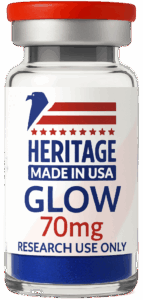
Glow is a research blend of three peptides co-lyophilized in one 70 mg vial: GHK-Cu (50 mg), BPC-157 (10 mg) and TB-500 (10 mg). GHK-Cu makes up most of the vial, so the blend centers on skin and connective-tissue research, with BPC-157 and TB-500 adding blood-vessel and cell-migration research alongside it.
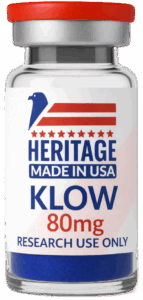
Heritage Labs sells Glow 50/10/10 for laboratory research use only. For the four-peptide version that adds KPV, see the KLOW Peptide Blend Guide.
What Is in the Vial
| Ingredient | Amount | What it is | Main research focus |
|---|---|---|---|
| GHK-Cu | 50 mg | Copper tripeptide-1: Gly-His-Lys bound to a copper(II) ion, found naturally in human plasma | Collagen and matrix remodeling, skin-repair models, gene-expression studies |
| BPC-157 | 10 mg | 15-amino-acid peptide, a partial sequence of a protein found in human gastric juice | Blood-vessel growth, tendon and ligament models |
| TB-500 | 10 mg | Synthetic thymosin beta-4: 43 amino acids with the LKKTETQ actin-binding motif | Cell migration and wound-repair models |
Total peptide content is 70 mg per vial, supplied as a co-lyophilized (freeze-dried) powder.
Why These Three Peptides Are Combined
Rebuilding skin and connective tissue in laboratory models depends on three things working together: a supply of new blood vessels, cells moving into the area, and new structural matrix (collagen and related molecules) being laid down. Each Glow ingredient has been studied for one of those:
| What the tissue needs | Ingredient | Research focus |
|---|---|---|
| New structural matrix | GHK-Cu (50 mg) | Collagen, decorin and glycosaminoglycan synthesis; matrix turnover |
| New blood vessels | BPC-157 (10 mg) | Angiogenesis through the VEGFR2–Akt–eNOS pathway |
| Cells moving in | TB-500 (10 mg) | Actin control and cell migration |
The heavy GHK-Cu share reflects the blend's focus on matrix and skin research; BPC-157 and TB-500 cover the supporting steps. We are not aware of peer-reviewed studies of the three-peptide Glow combination itself; the research behind it is the research on each ingredient, summarized below.
What Research Has Studied
GHK-Cu
- Matrix building: GHK-Cu stimulates both the synthesis and the breakdown of collagen and glycosaminoglycans, increases decorin, and adjusts the enzymes that remodel the matrix (metalloproteinases and their inhibitors).[1]
- Repair models: it attracts immune and endothelial cells to an injury site and has accelerated wound repair of skin, hair follicles and other tissues in animal models.[1]
- Gene expression: analyses of gene-expression data associate GHK with changes in the activity of a large number of human genes.[2]
BPC-157
- In chick-embryo and rat hind-limb models and in endothelial-cell culture, BPC-157 promoted new blood-vessel formation through the VEGFR2–Akt–eNOS pathway.[3]
- In rat tendon explants, it increased fibroblast outgrowth, survival under oxidative stress, and migration.[4]
TB-500 (thymosin beta-4)
- In a rat full-thickness skin-wound model, thymosin beta-4 increased re-epithelialization, wound contraction, collagen deposition and blood-vessel formation, and stimulated keratinocyte migration.[5]
- It binds actin through its LKKTETQ motif and has been reviewed as a multi-functional regenerative peptide.[6]
Heritage's TB-500 is a synthetic version of the full 43-amino-acid thymosin beta-4 sequence; the studies above used thymosin beta-4.
Glow vs KLOW
| Glow 50/10/10 | KLOW | |
|---|---|---|
| Ingredients | GHK-Cu, BPC-157, TB-500 | GHK-Cu, BPC-157, TB-500, KPV |
| Amounts | 50 / 10 / 10 mg (70 mg) | 50 / 10 / 10 / 10 mg (80 mg) |
| Research focus | The rebuilding side: matrix, blood vessels, cell migration | The same, plus KPV for the inflammation-signaling side |
The full explanation of what KPV adds is in the KLOW guide.
How to Reconstitute Glow
Add bacteriostatic water slowly down the inside wall of the vial, then swirl gently until the powder dissolves; do not shake. If the solution stays cloudy or does not fully dissolve, use the two-step method in Acetic Acid Water vs BAC Water.
| Water added | Total peptide | GHK-Cu | BPC-157 | TB-500 |
|---|---|---|---|---|
| 2 mL | 35 mg/mL | 25 mg/mL | 5 mg/mL | 5 mg/mL |
| 3 mL | 23.33 mg/mL | 16.67 mg/mL | 3.33 mg/mL | 3.33 mg/mL |
| 5 mL | 14 mg/mL | 10 mg/mL | 2 mg/mL | 2 mg/mL |
For any other volume, use the reconstitution calculator.
Storage
- Lyophilized (unopened): store sealed at −20°C.
- Reconstituted: store at 2–8°C and use within 30 days.
- Keep vials out of light, and use a new sterile needle for every draw.
Frequently Asked Questions
What is the Glow peptide blend?
Glow is a research blend of GHK-Cu (50 mg), BPC-157 (10 mg) and TB-500 (10 mg) in one 70 mg vial, sold for laboratory research use only.
What is in Glow 50/10/10?
The numbers are the milligrams of each peptide: 50 mg GHK-Cu, 10 mg BPC-157 and 10 mg TB-500, co-lyophilized in a single vial.
Why are GHK-Cu, BPC-157 and TB-500 combined?
Each has been studied for a different part of rebuilding tissue in laboratory models: GHK-Cu for laying down new matrix such as collagen, BPC-157 for new blood-vessel growth, and TB-500 for cell migration. Combining them lets researchers study those together in one preparation.
What is the difference between Glow and KLOW?
KLOW is Glow plus 10 mg of KPV (80 mg total). KPV is a fragment of alpha-MSH studied for reducing inflammatory signaling, so KLOW adds the inflammation side to Glow's rebuilding focus.
How do you reconstitute Glow?
Add bacteriostatic water slowly down the inside of the vial and swirl gently until dissolved. In 2 mL, total peptide concentration is 35 mg/mL (GHK-Cu 25 mg/mL; BPC-157 and TB-500 5 mg/mL each).
How should Glow be stored?
Store sealed vials at −20°C. After reconstitution, refrigerate at 2–8°C and use within 30 days.
Where can I buy Glow for research?
Heritage Labs USA sells Glow 50/10/10. We are veteran-owned and ship from the United States; weekday orders placed before 12:00 PM ET ship the same day.
References
- Pickart L, Vasquez-Soltero JM, Margolina A. GHK Peptide as a Natural Modulator of Multiple Cellular Pathways in Skin Regeneration. Biomed Res Int. 2015;2015:648108. PubMed
- Pickart L, Margolina A. Regenerative and Protective Actions of the GHK-Cu Peptide in the Light of the New Gene Data. Int J Mol Sci. 2018;19(7):1987. PubMed
- Hsieh MJ, et al. Therapeutic potential of pro-angiogenic BPC157 is associated with VEGFR2 activation and up-regulation. J Mol Med (Berl). 2017;95(3):323-333. PubMed
- Chang CH, et al. The promoting effect of pentadecapeptide BPC 157 on tendon healing involves tendon outgrowth, cell survival, and cell migration. J Appl Physiol. 2011;110(3):774-780. PubMed
- Malinda KM, et al. Thymosin beta4 accelerates wound healing. J Invest Dermatol. 1999;113(3):364-368. PubMed
- Goldstein AL, Hannappel E, Sosne G, Kleinman HK. Thymosin β4: a multi-functional regenerative peptide. Basic properties and clinical applications. Expert Opin Biol Ther. 2012;12(1):37-51. PubMed
For laboratory research use only. Not for human or veterinary use.