
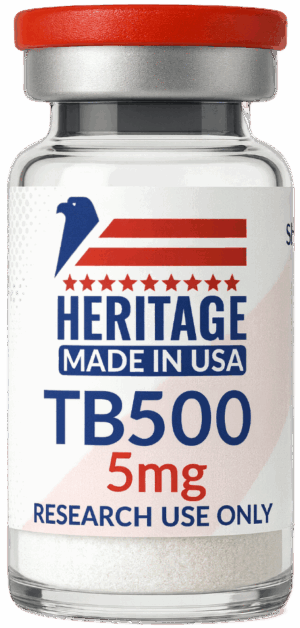
TB-500 5mg
Thymosin Beta-4 synthetic fragment — 43 amino acids with LKKTETQ actin-binding motif Published in Nature and The FASEB Journal — extensively studied actin-regulating peptide CAS 77591-33-4 For in vitro cell migration and actin research only
For laboratory research use only. Not for human or veterinary consumption. SKU TB5.
Product details.
Specifications
| Full Sequence | Ac-Ser-Asp-Lys-Pro-Asp-Met-Ala-Glu-Ile-Glu-Lys-Phe-Asp-Lys-Ser-Lys-Leu-Lys-Lys-Thr-Glu-Thr-Gln-Glu-Lys-Asn-Pro-Leu-Pro-Ser-Lys-Glu-Thr-Ile-Glu-Gln-Glu-Lys-Gln-Ala-Gly-Glu-Ser |
| Active Region | LKKTETQ (amino acids 17-23) |
| Molecular Formula | C212H350N56O78S |
| Molecular Weight | 4963.44 g/mol |
| CAS Number | 77591-33-4 |
| PubChem CID | 16132042 |
| Form | Lyophilized powder |
| Quantity | 5mg per vial |
The research record
Malinda et al. reported a 41% increase in re-epithelialization within 4 days in full-thickness dermal wound models, concluding that “Tβ4 is a potent wound healing factor with multiple activities” (J Investigative Dermatology, 1999; PubMed 10469335).
Bock-Marquette et al. published findings in Nature showing enhanced cardiomyocyte migration and survival through integrin-linked kinase (ILK) and Akt signaling activation in myocardial infarction models (Nature, 2004; PubMed 15565145).
Philp et al. characterized angiogenesis and directional cell migration in both normal and aged rodent models through endothelial tube formation and ECM remodeling (Annals NYAS, 2004; PubMed 15037013).
Goldstein et al. reviewed NF-κB signaling modulation, pro-inflammatory cytokine reduction, and decreased inflammatory cell infiltration in tissue models (Expert Opinion on Biological Therapy, 2012; PubMed 22074294).
TB-500 vs BPC-157
Different mechanisms for different systems. TB-500 research centers on actin regulation, cell migration, blood vessel formation, and cardiac tissue. BPC-157 research centers on gastrointestinal integrity, connective tissue, and nitric oxide pathways. Published protocols treat them as complementary, not interchangeable. Heritage Labs USA offers both individually and as a BPC-TB blend.
Research applications
- Cell migration and wound closure assays
- Actin polymerization dynamics and G-actin/F-actin equilibrium
- Angiogenesis pathway screening
- ECM remodeling and collagen expression
- Inflammatory signaling profiling
- Cardiac cell survival and ILK activation
Frequently paired with
- BPC-157 5mg — Available as BPC-TB Blend.
- GHK-Cu 50mg — Available in Glow 50/10/10.
Quality and testing
Third-party tested by an independent lab for identity, density and purity. Certificates of analysis are published on the product page and in the COA portal. Manufactured to research-grade standards and shipped in protective packaging.
Storage
- Lyophilized: -20°C (up to 12 months sealed)
- Reconstituted: 2-8°C, use within 30 days
- Protection: Shield from light and moisture; avoid freeze-thaw cycles
- Handling: Let the vial reach room temperature before opening to prevent condensation
References
- Malinda KM, et al. J Investigative Dermatology. 1999;113(3):364-368. PubMed 10469335
- Bock-Marquette I, et al. Nature. 2004;432(7016):466-472. PubMed 15565145
- Philp D, et al. Annals NYAS. 2004;1012:44-52. PubMed 15037013
- Goldstein AL, et al. Expert Opinion on Biological Therapy. 2012;12(1):37-51. PubMed 22074294
- Kleinman HK, Sosne G. Vitamins and Hormones. 2016;102:251-275. PubMed 27450738
FAQ
What is TB-500?
A synthetic 43-amino-acid peptide corresponding to Thymosin Beta-4, an endogenous actin-sequestering protein. Subject of extensive preclinical research in wound repair, cardiac tissue, inflammation, and cell migration.
TB-500 vs Thymosin Beta-4?
Same molecule. TB-500 is the synthetic research-grade form of the naturally occurring protein. The terms are interchangeable in the literature.
Is TB-500 approved for human use?
No. TB-500 is a research compound, not approved by the FDA for any human use. Heritage Labs USA products are strictly for laboratory research.
For laboratory research use only. Not for human or veterinary use. Not a drug, food, or cosmetic.
FDA Disclaimer. All products are for research use only (RUO) as defined by the FDA — not for diagnostic, human, or veterinary use. These products have not been evaluated and have not been approved by the U.S. Food and Drug Administration and are not intended to diagnose, treat, cure, or prevent any disease.
Heritage Labs is a chemical supplier providing products strictly for laboratory research, analytical, and in-vitro purposes; it is not a compounding pharmacy or compounding facility under Section 503A, nor an outsourcing facility under Section 503B, of the Federal Food, Drug, and Cosmetic Act.