
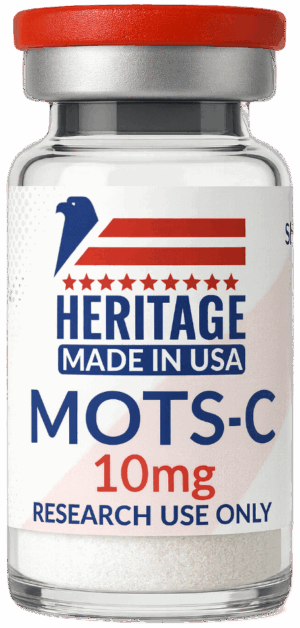
MOTS-C 10mg
Mitochondrial-derived peptide — 16 amino acids encoded by the 12S rRNA gene region First described in 2015 — studied in AMPK pathway activation and mitochondrial-nuclear signaling Research-grade · CAS 1627580-64-6 For in vitro metabolic pathway research only
For laboratory research use only. Not for human or veterinary consumption. SKU MS10.
Product details.
Specifications
| Sequence | Met-Arg-Trp-Gln-Glu-Met-Gly-Tyr-Ile-Phe-Tyr-Pro-Arg-Lys-Leu-Arg |
| Amino Acids | 16 |
| Molecular Formula | C101H152N28O22S2 |
| Molecular Weight | 2174.64 g/mol |
| CAS Number | 1627580-64-6 |
| Gene Origin | Mitochondrial 12S rRNA gene region |
| Form | Lyophilized powder |
| Quantity | 10mg per vial |
An indirect route to AMPK
MOTS-C does not hit AMPK directly the way pharmaceutical activators do. Instead, it inhibits the folate cycle, which causes AICAR (5-aminoimidazole-4-carboxamide ribonucleotide) to accumulate. AICAR is an endogenous AMPK activator. So MOTS-C activates the central energy sensor of the cell, but through an upstream metabolic bottleneck rather than direct kinase binding. Under stress conditions, the peptide translocates from mitochondria to the nucleus to regulate gene expression — a retrograde signal where the organelle talks back to the genome.
MOTS-C vs NAD+
Both sit at the intersection of energy metabolism and cellular signaling, but through different nodes. NAD+ fuels sirtuins, PARPs, and the electron transport chain. MOTS-C activates AMPK through the folate cycle. Complementary pathways, not redundant ones. Heritage Labs USA carries both.
Research applications
- AMPK pathway activation and downstream signaling
- Folate-methionine cycle and AICAR accumulation
- Mitochondrial-nuclear retrograde signaling
- Glucose uptake and fatty acid oxidation studies
- Cellular stress response and metabolic adaptation
Frequently paired with
- BPC-157 5mg — Complementary recovery pathways.
- NAD+ 1000mg — AMPK + sirtuin axis research.
Quality and testing
Third-party tested by an independent lab for identity, density and purity. Certificates of analysis are published on the product page and in the COA portal. Manufactured to research-grade standards and shipped in protective packaging.
Storage
- Lyophilized: -20°C
- Reconstituted: 2-8°C, use within 30 days
For laboratory research use only. Not for human or veterinary use.

FDA Disclaimer. All products are for research use only (RUO) as defined by the FDA — not for diagnostic, human, or veterinary use. These products have not been evaluated and have not been approved by the U.S. Food and Drug Administration and are not intended to diagnose, treat, cure, or prevent any disease.
Heritage Labs is a chemical supplier providing products strictly for laboratory research, analytical, and in-vitro purposes; it is not a compounding pharmacy or compounding facility under Section 503A, nor an outsourcing facility under Section 503B, of the Federal Food, Drug, and Cosmetic Act.