
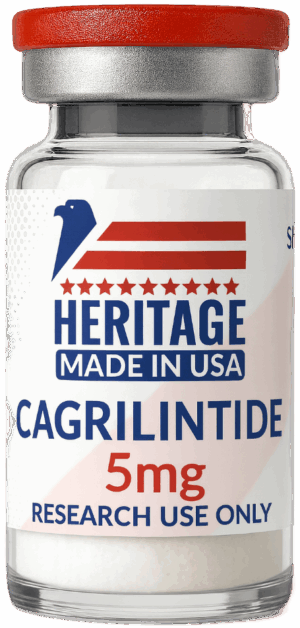
Cagrilintide 5mg
Synthetic long-acting amylin analog — 37 amino acids with acylated C18 fatty diacid modification Targets AMY1, AMY2, and AMY3 receptor subtypes Research-grade · Lyophilized powder For in vitro amylin receptor research only
For laboratory research use only. Not for human or veterinary consumption. SKU CGL5.
Product details.
Specifications
| Amino Acids | 37 |
| Classification | Long-acting amylin receptor agonist |
| Modification | C18 fatty diacid acylation for albumin binding |
| Molecular Weight | ~4,034 Da (acylated form) |
| CAS Number | 2196070-45-4 |
| Purity | Research-grade |
| Form | Lyophilized powder |
| Quantity | 5mg per vial |
Molecular Design and Albumin Binding
Native human amylin (islet amyloid polypeptide, IAPP) has a circulating half-life measured in minutes, limiting its utility in sustained-exposure research models. Cagrilintide addresses this through C18 fatty diacid acylation — a lipidation strategy that enables reversible, non-covalent binding to serum albumin. This albumin association creates a circulating depot effect, substantially extending the pharmacokinetic profile compared to unmodified amylin. The approach is conceptually related to the Drug Affinity Complex (DAC) used in CJC-1295, though the underlying chemistry differs. Lau et al. described the design rationale for acylated amylin analogs in the context of sustained receptor engagement (Lau et al., Journal of Medicinal Chemistry, 2015; PubMed 26288685).
Amylin Receptor Pharmacology
The amylin receptor system represents one of the more intricate GPCR signaling networks studied in metabolic research. The three receptor subtypes — AMY1 (CTR + RAMP1), AMY2 (CTR + RAMP2), and AMY3 (CTR + RAMP3) — each exhibit distinct ligand affinity profiles and tissue distribution patterns. Cagrilintide has been investigated for its binding characteristics across all three subtypes. Downstream signaling involves cAMP accumulation through Gαs coupling, with additional contributions from β-arrestin recruitment and receptor internalization pathways (Hay et al., Pharmacological Reviews, 2015; PubMed 26023145). Understanding subtype-selective signaling is a key area of ongoing amylin receptor research.
Published Research and Preclinical Data
Cagrilintide has been examined in multiple preclinical contexts. Lau et al. demonstrated that long-acting amylin analogs produce sustained receptor activation in rodent models, enabling researchers to study the physiological consequences of prolonged amylin signaling rather than the brief, pulsatile exposure that native IAPP provides (PubMed 26288685). Separate investigations have explored cagrilintide in combination with semaglutide (a GLP-1 receptor agonist), examining the distinct but complementary signaling pathways activated by amylin and GLP-1 receptor engagement in area postrema and hypothalamic circuits (Enebo et al., The Lancet, 2021; PubMed 34004180).
Research Applications
- Amylin receptor subtype (AMY1/2/3) binding selectivity and signaling bias studies
- CTR/RAMP heterodimer formation and modulation research
- Acylated peptide pharmacokinetics — albumin binding dynamics and depot release modeling
- Comparative structure-activity analysis of amylin analogs (pramlintide, native IAPP, cagrilintide)
- Dual-pathway investigation pairing amylin receptor agonism with GLP-1 or GIP receptor activation
- Area postrema and hindbrain neuronal circuit mapping in metabolic signaling models
Frequently Paired With
- SM1 5mg — Enables dual-pathway investigation: amylin signaling through hindbrain circuits alongside GLP-1 receptor engagement through hypothalamic pathways.
Quality and testing
Every Heritage Labs compound is manufactured to research-grade standards and shipped in protective packaging.
Storage
- Lyophilized: Store at -20°C, protected from light and moisture
- Reconstituted: 2-8°C, use within 30 days
- Avoid repeated freeze-thaw cycles
References
- Lau J, et al. Journal of Medicinal Chemistry. 2015;58(18):7370-7380. PubMed 26288685
- Hay DL, et al. Pharmacological Reviews. 2015;67(3):564-600. PubMed 26023145
- Enebo LB, et al. The Lancet. 2021;397(10286):1736-1748. PubMed 34004180
For laboratory research use only. Not for human or veterinary use.

FDA Disclaimer. All products are for research use only (RUO) as defined by the FDA — not for diagnostic, human, or veterinary use. These products have not been evaluated and have not been approved by the U.S. Food and Drug Administration and are not intended to diagnose, treat, cure, or prevent any disease.
Heritage Labs is a chemical supplier providing products strictly for laboratory research, analytical, and in-vitro purposes; it is not a compounding pharmacy or compounding facility under Section 503A, nor an outsourcing facility under Section 503B, of the Federal Food, Drug, and Cosmetic Act.