
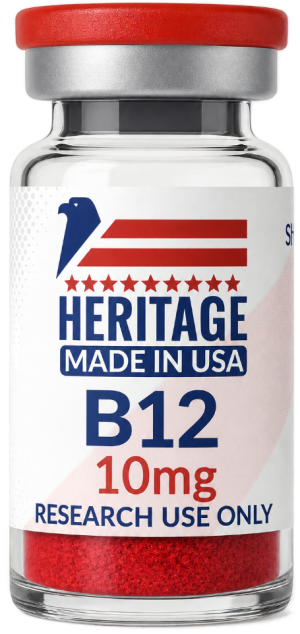
B12 10mg
Active coenzyme form of vitamin B12 (methylcobalamin) — direct methionine synthase cofactor Studied in methylation cycle, homocysteine metabolism, and nervous-system research 10mg per 10 mL solution · Third-party lab tested · CAS 13422-55-4 For in vitro methylation and metabolic research only
For laboratory research use only. Not for human or veterinary consumption. SKU B12P.
Product details.
Vitamin B12 is not a single molecule but a family of cobalamins, and they are not interchangeable. Cyanocobalamin — the cheap, shelf-stable form in most catalogs — is inert until the cell strips off its cyanide group and rebuilds it. Methylcobalamin skips that step: it is one of the two coenzyme forms the body actually uses, and it is the exact cofactor that methionine synthase reaches for in the methylation cycle. At the center sits a cobalt ion held in a corrin ring, joined to a methyl group by a cobalt–carbon bond — one of the very few naturally occurring organometallic compounds in biology. This listing is the 10 mL solution presentation.
Specifications
| Compound | Methylcobalamin (Vitamin B12, methyl form) |
| Molecular Formula | C63H91CoN13O14P |
| Molecular Weight | 1344.38 g/mol |
| CAS Number | 13422-55-4 |
| Central Atom | Cobalt (Co3+), corrin ring, Co–C methyl bond |
| Appearance | Red crystalline solid / red solution |
| Form | Solution |
| Quantity | 10mg per 10 mL vial |
The active coenzyme form
Of the four common cobalamins, only two are biologically active coenzymes: methylcobalamin and adenosylcobalamin. Methylcobalamin is the form bound by methionine synthase in the cytosol; adenosylcobalamin serves methylmalonyl-CoA mutase in the mitochondria. Cyanocobalamin and hydroxocobalamin are precursors that must be enzymatically converted before either coenzyme role can proceed. Methylcobalamin enters research models already in the usable state, which is why it is the reference form for methylation-cycle work.
The methylation cycle
Methionine synthase carries a methyl group from 5-methyltetrahydrofolate to homocysteine, regenerating methionine — and methylcobalamin is the intermediate that shuttles that methyl group. Methionine is then activated to S-adenosylmethionine (SAM), the universal methyl donor for DNA, RNA, protein, and neurotransmitter methylation. This places methylcobalamin at the junction of the folate cycle, homocysteine metabolism, and the entire cellular methylation economy.
A rare organometallic
Cobalamins are the largest and most structurally complex of the vitamins, and methylcobalamin is notable in coordination chemistry as one of the few stable compounds carrying a metal–alkyl bond. That cobalt–carbon bond is photolabile — it cleaves on exposure to light — which is why the solution is handled and stored protected from light.
Methylcobalamin vs Cyanocobalamin
Same vitamin, different upper ligand and very different research profiles. Cyanocobalamin carries a cyanide group and is a stable storage form that the cell must convert. Methylcobalamin carries the methyl group and is a ready coenzyme. Studies of methylation-cycle activity, methionine synthase, and homocysteine biochemistry use the methyl form specifically; the cyano form is a precursor, not a substitute.
Research applications
- Methylation cycle and one-carbon metabolism models
- Methionine synthase activity and homocysteine remethylation
- SAM-dependent methylation and methyl-donor availability studies
- Folate–cobalamin interaction research
- Nervous-system and myelin biology models
- Erythropoiesis and red blood cell biology
Frequently paired with
- NAD+ 500mg — Adjacent cellular-energy and cofactor research.
- MOTS-C 10mg — Metabolic-pathway studies.
Quality and testing
Third-party tested by an independent lab for identity, density and purity. Certificates of analysis are published on the product page and in the COA portal. Manufactured to research-grade standards and shipped in protective packaging.
Storage
- Solution: 2-8°C, refrigerated
- Protection: Shield from light at all times — the Co–C bond is photolabile
- Handling: Keep sealed; avoid prolonged room-temperature exposure
FAQ
What is methylcobalamin?
The methylated, biologically active coenzyme form of vitamin B12. It is the cofactor used directly by methionine synthase in the methylation cycle, subject of extensive research in one-carbon metabolism and homocysteine biochemistry.
Methylcobalamin vs cyanocobalamin?
Methylcobalamin is an active coenzyme; cyanocobalamin is an inert storage precursor that must be converted in the cell. Research on methylation-cycle function uses the methyl form specifically.
Is B12 approved for human use?
No. This methylcobalamin solution is a research compound, not approved by the FDA for any human use. Heritage Labs USA products are strictly for laboratory research.
For laboratory research use only. Not for human or veterinary use. Not a drug, food, dietary supplement, or cosmetic.
FDA Disclaimer. All products are for research use only (RUO) as defined by the FDA — not for diagnostic, human, or veterinary use. These products have not been evaluated and have not been approved by the U.S. Food and Drug Administration and are not intended to diagnose, treat, cure, or prevent any disease.
Heritage Labs is a chemical supplier providing products strictly for laboratory research, analytical, and in-vitro purposes; it is not a compounding pharmacy or compounding facility under Section 503A, nor an outsourcing facility under Section 503B, of the Federal Food, Drug, and Cosmetic Act.