
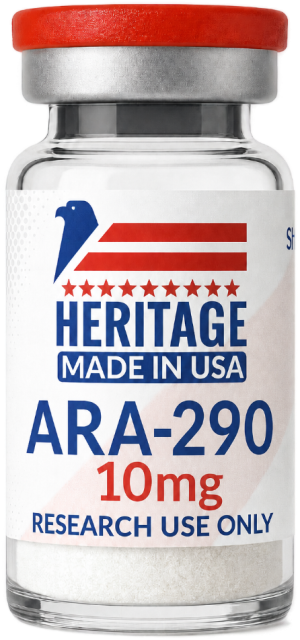
ARA-290 10mg
Non-erythropoietic EPO derivative — 11-amino-acid helix B surface peptide (cibinetide) Studied as an innate repair receptor (EPOR/CD131) agonist in small-fiber neuropathy models 10mg per vial · Third-party lab tested · CAS 1208243-50-8 For in vitro tissue-protection and inflammatory signaling research only
For laboratory research use only. Not for human or veterinary consumption. SKU ARA10.
Product details.
Specifications
| Sequence | pGlu-Glu-Gln-Leu-Glu-Arg-Ala-Leu-Asn-Ser-Ser |
| Amino Acids | 11 (pyroglutamate N-terminus) |
| Molecular Formula | C51H84N16O21 |
| Molecular Weight | 1257.32 g/mol |
| CAS Number | 1208243-50-8 |
| PubChem CID | 91810664 |
| Origin | EPO helix B surface region (non-erythropoietic) |
| Form | Lyophilized powder |
| Quantity | 10mg per vial |
The innate repair receptor
Classic erythropoiesis signals through a homodimer of the EPO receptor (EPOR). The tissue-protective activity travels a different route: a heteromeric complex of EPOR and the β-common receptor (CD131), often called the innate repair receptor. ARA-290 was designed to engage this heterocomplex selectively. Because it does not activate the homodimeric EPOR, research models report tissue-protective and anti-inflammatory signaling without the rise in hematocrit that accompanies erythropoietin itself.
Why a helix B fragment
Mapping studies of the EPO molecule located its tissue-protective determinants on the surface of helix B — residues that face outward and are not involved in high-affinity binding to the erythropoietic receptor. Reducing the molecule to that surface loop produced a short, stable peptide that retains innate-repair-receptor signaling. ARA-290 is that peptide.
Research applications
- Innate repair receptor (EPOR/CD131) signaling assays
- Small-fiber neuropathy and corneal nerve fiber models
- Neuropathic and inflammatory pain pathway screening
- Sarcoidosis and chronic-inflammation tissue models
- Cytokine profiling and macrophage polarization studies
- Tissue-protection and repair assays independent of erythropoiesis
The research record
ARA-290 has been evaluated in controlled clinical research for small-fiber neuropathy, including a study of corneal nerve fiber density and neuropathic symptoms in subjects with sarcoidosis (ClinicalTrials.gov NCT02039687). The broader body of work characterizing EPO’s tissue-protective, non-erythropoietic signaling and its separation from erythropoiesis established the rationale for helix-B-derived peptides such as this one.
ARA-290 vs EPO
Same origin, deliberately divergent activity. Erythropoietin engages the homodimeric EPO receptor and raises red blood cell mass. ARA-290 engages only the EPOR/CD131 innate repair receptor, isolating the tissue-protective arm of EPO signaling. Research protocols regard them as distinct tools, not substitutes.
Frequently paired with
- BPC-157 5mg — Complementary tissue-repair pathways.
- MOTS-C 10mg — Metabolic and cellular-stress signaling.
Quality and testing
Third-party tested by an independent lab for identity, density and purity. Certificates of analysis are published on the product page and in the COA portal. Manufactured to research-grade standards and shipped in protective packaging.
Storage
- Lyophilized: -20°C
- Reconstituted: 2-8°C, use within 30 days
- Protection: Shield from light and moisture; avoid freeze-thaw cycles
FAQ
What is ARA-290?
An 11-amino-acid peptide, also called cibinetide, modeled on the helix B surface region of erythropoietin. It is a non-erythropoietic research compound studied as an agonist of the innate repair receptor.
ARA-290 vs cibinetide?
Same molecule. ARA-290 is the developmental code; cibinetide is the assigned nonproprietary name.
Is ARA-290 approved for human use?
No. ARA-290 is a research compound, not approved by the FDA for any human use. Heritage Labs USA products are strictly for laboratory research.
For laboratory research use only. Not for human or veterinary use. Not a drug, food, or cosmetic.
FDA Disclaimer. All products are for research use only (RUO) as defined by the FDA — not for diagnostic, human, or veterinary use. These products have not been evaluated and have not been approved by the U.S. Food and Drug Administration and are not intended to diagnose, treat, cure, or prevent any disease.
Heritage Labs is a chemical supplier providing products strictly for laboratory research, analytical, and in-vitro purposes; it is not a compounding pharmacy or compounding facility under Section 503A, nor an outsourcing facility under Section 503B, of the Federal Food, Drug, and Cosmetic Act.