
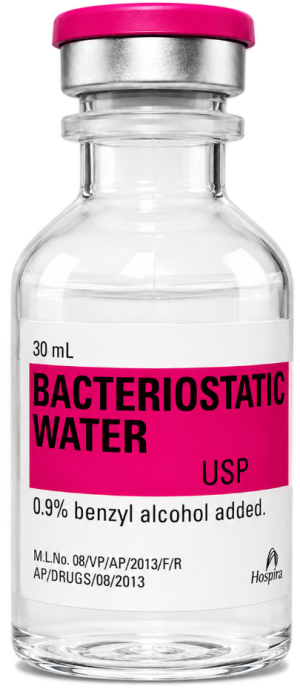
Hospira Reconstitution Solution 30ml
Hospira Bacteriostatic Water, USP — pharmaceutical-grade sterile diluent 30 mL multi-use vial — 0.9% benzyl alcohol preservative, 28-day multi-use window The industry benchmark solvent for lyophilized research peptides · pH 4.5–7.0 · Type I borosilicate glass For laboratory research use only
For laboratory research use only. Not for human or veterinary consumption. SKU WA30.
Product details.
Why Hospira Is Top Shelf
Not all bacteriostatic water is equal. The difference between a pharmaceutical-grade product and a generic fill is process control: validated aseptic manufacturing, lot-level endotoxin and sterility release testing, and container-closure integrity engineered to hold sterility across the full labeled shelf life. Hospira built its reputation on exactly that discipline. Choosing Hospira reconstitution solution removes a variable from the bench — the solvent is never the question.
Specifications
| Brand | Hospira |
| Volume | 30 mL |
| Composition | Sterile Water (USP) + 0.9% Benzyl Alcohol (NF) |
| Appearance | Clear, colorless, free of visible particulates |
| pH Range | 4.5–7.0 |
| Container | Type I borosilicate glass vial, rubber stopper, aluminum crimp seal |
| Grade | USP · Pharmaceutical |
Benzyl Alcohol: Multi-Use Preservation
Benzyl alcohol (C6H5CH2OH, molecular weight 108.14 g/mol, CAS 100-51-6) is a bacteriostatic preservative — it inhibits bacterial reproduction by disrupting membrane integrity and membrane-associated transport, preventing colonization of the solution after the sealed environment is first breached by a needle. At the 0.9% concentration specified by USP, benzyl alcohol supports repeated draws from a single vial across a 28-day window (United States Pharmacopeia, General Chapter <51> Antimicrobial Effectiveness Testing). It does not hydrolyze peptide bonds under standard storage conditions (2–8°C) and is compatible with the vast majority of research peptides.
The 30 mL Advantage
The 30 mL format is built for the serious bench. A researcher reconstituting ten compounds at 2 mL each needs 20 mL of solvent — a single Hospira 30 mL vial consolidates that into one container with one 28-day tracking date, instead of juggling six or seven small vials on their own separate clocks. Fewer punctures spread across a larger stopper, one lot to document, and the lowest per-milliliter cost in the Heritage reconstitution lineup — packaging, sterilization, and release testing are fixed costs per vial regardless of fill volume, so volume wins.
Choosing Your Solvent
Lyophilized peptides ship as dry powder to protect chemical stability in transit; an appropriate solvent must be added before use in research. Bacteriostatic (reconstitution) solution is the preferred choice for most compounds because the preservative permits multi-use access to a reconstituted vial over 28 days — essential for protocols that draw small volumes across many sessions. Alternatives include preservative-free sterile water (single-use only), acetic acid water (0.6%, for compounds with poor neutral-pH solubility), and 0.9% sodium chloride (isotonic saline). For the majority of lyophilized peptides — GHRPs, GHRH analogs, BPC-157, and melanocortin peptides among them — bacteriostatic reconstitution solution is the standard, and Hospira is the standard-bearer.
Handling and Storage
Store unopened vials at controlled room temperature (20–25°C) in original packaging, away from direct sunlight. Do not freeze — freezing can compromise the seal or create invisible micro-fractures in the glass. After first puncture, refrigerate at 2–8°C and mark the date; the 28-day window begins at first puncture, not receipt. Before each draw, disinfect the stopper with a 70% isopropyl alcohol swab and let it air-dry, and use a fresh sterile needle (29–31 gauge) each time, varying the puncture site across the stopper to distribute wear. Discard the vial if the stopper shows visible damage or sheds fragments, regardless of remaining volume.
Reconstitution Best Practices
Invert the vial and insert the needle through the center of the stopper; draw slowly to avoid air bubbles that spoil measurement accuracy. Direct the solvent stream down the inside glass wall of the peptide vial rather than onto the powder cake, then swirl gently in a circular motion until fully dissolved. Do not shake, vortex, or invert vigorously — mechanical agitation can denature peptide secondary structure. For a complete protocol with concentration calculations, see the Heritage Labs Reconstitution Guide.
Quality Verification
This is genuine Hospira Bacteriostatic Water, USP, produced to United States Pharmacopeia specification by Hospira. Vials undergo visual inspection for particulates and container integrity. We do not COA-test water: a Certificate of Analysis covers our research peptides, not bacteriostatic water, acetic acid, or reconstitution solutions.
Size Guide
Choose the 30 mL Hospira vial when more than 10 mL of solvent will be consumed within a 28-day window, or when working across many compounds at once. For lighter benches, the 3 mL and 10 mL reconstitution solutions, acetic acid water, and the full research peptide catalog are available in the Heritage Labs shop. For laboratory research use only. Not for human or veterinary use.


FDA Disclaimer. All products are for research use only (RUO) as defined by the FDA — not for diagnostic, human, or veterinary use. These products have not been evaluated and have not been approved by the U.S. Food and Drug Administration and are not intended to diagnose, treat, cure, or prevent any disease.
Heritage Labs is a chemical supplier providing products strictly for laboratory research, analytical, and in-vitro purposes; it is not a compounding pharmacy or compounding facility under Section 503A, nor an outsourcing facility under Section 503B, of the Federal Food, Drug, and Cosmetic Act.