
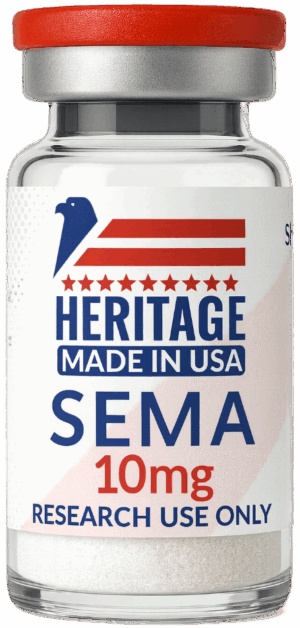
Semaglutide 10mg (GLP-1)
Synthetic peptide analog — 31 amino acids · Standard 10mg research quantity For receptor interaction and signaling pathway research Research-grade · Lyophilized powder For in vitro research only
For laboratory research use only. Not for human or veterinary consumption. SKU SM10.
Product details.
The engineering behind it
Two problems had to be solved. First, resistance to DPP-IV cleavage — the enzyme that makes native GLP-1 nearly useless as a research tool due to its rapid degradation. Second, a way to extend circulation time without altering receptor binding. The C18 fatty acid acylation addresses both: it provides steric protection from enzymatic degradation and enables reversible, non-covalent albumin association that keeps the peptide in circulation far longer than the native hormone. The receptor interaction itself is well-characterized. SM1 activates GLP-1 receptors on pancreatic beta cells, initiating a cAMP/PKA signaling cascade that drives glucose-dependent insulin secretion. The key phrase is glucose-dependent — GLP-1 receptor agonists work with existing glucose levels rather than forcing insulin release regardless of metabolic state.
Specifications
| Amino Acids | 31 |
| Classification | Selective GLP-1 receptor agonist |
| Modification | C18 fatty acid acylation for albumin binding |
| Form | Lyophilized powder |
| Quantity | 10mg per vial |
What the research shows
Hypothalamic appetite regulation
GLP-1 receptors are expressed in the arcuate nucleus and other appetite-regulating brain regions. Preclinical studies have examined how receptor agonism at these central sites modulates feeding behavior and energy balance through both peripheral and central signaling pathways.
Metabolic pathway studies
Research models have examined GLP-1 receptor activation in the context of glucose homeostasis, insulin sensitivity, hepatic glucose output, and overall energy balance as part of the broader incretin signaling axis.
Frequently paired with
- Cagrilintide 5mg — Amylin analog. Amylin and GLP-1 act through distinct neuronal circuits (hindbrain vs hypothalamic), making them complementary research targets.
- AOD-9604 5mg — HGH Fragment 176-191 for comparative metabolic research.
- MOTS-C 10mg — AMPK pathway activation and cellular energy metabolism.
Quality and testing
Every Heritage Labs compound is manufactured to research-grade standards and shipped in protective packaging.
Storage
- Lyophilized: -20°C for long-term stability
- Reconstituted: 2-8°C, use within 30 days
- Protection: Keep away from light and moisture
For laboratory research use only. Not for human or veterinary use.

FDA Disclaimer. All products are for research use only (RUO) as defined by the FDA — not for diagnostic, human, or veterinary use. These products have not been evaluated and have not been approved by the U.S. Food and Drug Administration and are not intended to diagnose, treat, cure, or prevent any disease.
Heritage Labs is a chemical supplier providing products strictly for laboratory research, analytical, and in-vitro purposes; it is not a compounding pharmacy or compounding facility under Section 503A, nor an outsourcing facility under Section 503B, of the Federal Food, Drug, and Cosmetic Act.