
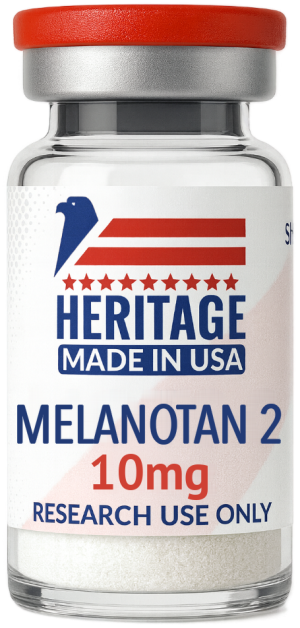
Melanotan 2 10mg
Synthetic α-MSH analog — cyclic heptapeptide · 10mg research quantity MC1R / MC4R melanocortin receptor agonist (parent compound of PT-141 / bremelanotide) Research-grade · CAS 121062-08-6 For in vitro melanocortin receptor and pigmentation research only
For laboratory research use only. Not for human or veterinary consumption. SKU MT2.
Product details.
Specifications
| Sequence | Ac-Nle-cyclo[Asp-His-D-Phe-Arg-Trp-Lys]-NH2 |
| Molecular Formula | C50H69N15O9 |
| Molecular Weight | 1024.18 g/mol |
| CAS Number | 121062-08-6 |
| Classification | Non-selective MC1R / MC4R melanocortin receptor agonist |
| Form | Lyophilized powder |
| Quantity | 10mg per vial |
Melanocortin receptor pharmacology
The melanocortin family covers a spread of physiological signaling that runs from cutaneous pigment biology to central appetite regulation, energy expenditure, and inflammatory response modulation. MT-2 was synthesized to enable cleaner experimental access to these pathways by overcoming the two main limitations of α-MSH itself: poor pharmacokinetic stability and a flat affinity profile across all five MC receptor subtypes. MC1R, expressed predominantly on melanocytes, is the receptor most associated with eumelanin synthesis and UV-independent melanogenesis research. MC4R, expressed throughout the hypothalamus, has been the dominant focus of energy-homeostasis and feeding-behavior studies. MT-2’s potency at both subtypes makes it a useful single-compound model for parallel investigation of dermatological and central-nervous-system melanocortin signaling within the same study design.
Relationship to PT-141
Removing the C-terminal amide from MT-2 yields bremelanotide (PT-141), which shifts the receptor selectivity profile toward MC3R/MC4R while substantially reducing MC1R engagement. Investigators interested in dissecting MC1R-dominant versus MC3R/MC4R-dominant signaling commonly pair these two compounds — MT-2 as the broader-spectrum probe, PT-141 as the central-nervous-system-biased counterpart — to attribute observed effects to specific receptor subtypes within the same experimental framework.
Handling and reconstitution
Supplied as lyophilized powder. Reconstitute with bacteriostatic water for in vitro studies; store reconstituted material at 2–8°C and use within published peptide stability windows. Long-term storage of sealed lyophilized vials at –20°C preserves potency for documented timeframes.
Quality and testing
Third-party tested by an independent lab for identity, density and purity. Certificates of analysis are published on the product page and in the COA portal. Manufactured to research-grade standards and shipped in protective packaging.
For laboratory research use only. Not for human or veterinary use. Not for diagnostic or therapeutic application.

FDA Disclaimer. All products are for research use only (RUO) as defined by the FDA — not for diagnostic, human, or veterinary use. These products have not been evaluated and have not been approved by the U.S. Food and Drug Administration and are not intended to diagnose, treat, cure, or prevent any disease.
Heritage Labs is a chemical supplier providing products strictly for laboratory research, analytical, and in-vitro purposes; it is not a compounding pharmacy or compounding facility under Section 503A, nor an outsourcing facility under Section 503B, of the Federal Food, Drug, and Cosmetic Act.