
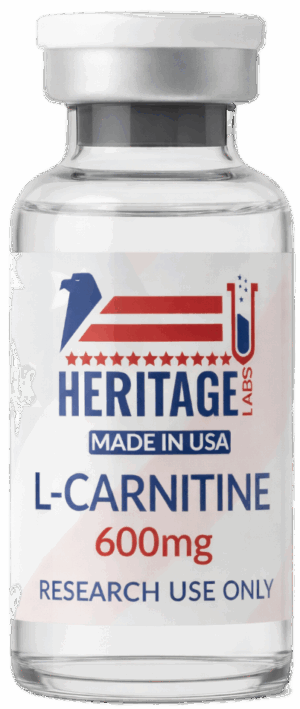
L-Carnitine 600mg
Amino acid derivative (Lys/Met-derived) — essential for mitochondrial fatty acid transport Key component of the carnitine palmitoyltransferase (CPT) shuttle system CAS 541-15-1 · 600mg For in vitro metabolic pathway research only
For laboratory research use only. Not for human or veterinary consumption. SKU LC600.
Product details.
Molecular Profile
L-Carnitine (levocarnitine) is a naturally occurring quaternary ammonium compound with the systematic name (R)-3-hydroxy-4-(trimethylammonio)butanoate. Its molecular formula is C7H15NO3, and it has a molecular weight of 161.20 g/mol. The compound is a small, water-soluble zwitterion — it carries both a positive charge (quaternary ammonium group) and a negative charge (carboxylate group) at physiological pH. This dual-charge structure is what makes L-Carnitine highly soluble in aqueous solutions, which is why it can be formulated as a stable liquid rather than requiring lyophilization.
The “L” prefix denotes the biologically active stereoisomer. Carnitine has a single chiral center, and only the L-form is found in biological systems. The D-form (D-carnitine) is not biologically active and is not used in research formulations. Heritage Labs L-Carnitine is the pure L-stereoisomer, verified by chiral analysis.
Biochemical Context
L-Carnitine was first isolated from meat extract by Gulewitsch and Krimberg in 1905, and its chemical structure was established by Tomita and Sendju in 1927. Its role in fatty acid metabolism was elucidated by Fritz (1955) in a landmark publication demonstrating that carnitine facilitates the transport of long-chain fatty acids across the mitochondrial membrane — a process now known as the “carnitine shuttle.” This finding, published in Acta Physiologica Scandinavica, established the foundational understanding of carnitine’s biochemical function.
Bremer (1983) published a comprehensive review in Physiological Reviews that detailed the carnitine palmitoyltransferase (CPT) system, the enzyme complex responsible for conjugating fatty acids to carnitine for mitochondrial transport. This work established the CPT-I and CPT-II enzyme system as a central regulatory node in fatty acid oxidation. Subsequent research by McGarry and Brown (1997), published in the European Journal of Biochemistry, further characterized the regulation of CPT-I by malonyl-CoA, positioning carnitine at the intersection of fatty acid synthesis and oxidation pathways.
Rebouche (1992) published a detailed review in the FASEB Journal covering L-Carnitine biosynthesis, tissue distribution, and the molecular genetics of carnitine transport. The review cataloged the known carnitine transport proteins (OCTN2 and others) and the metabolic consequences of carnitine deficiency in various tissue types. This body of literature has made L-Carnitine one of the most thoroughly characterized compounds in metabolic biochemistry.
Injectable Format — Why Liquid?
Most research peptides are supplied as lyophilized powders because peptides are fragile molecules that degrade rapidly in aqueous solution. L-Carnitine is fundamentally different. As a small, stable molecule with no peptide bonds, no secondary structure, and no sensitivity to hydrolysis, it is inherently stable in aqueous solution. The injectable liquid format eliminates the reconstitution step entirely — there is no lyophilized powder to dissolve, no solvent selection to consider, and no concentration calculation required.
The 600 mg concentration in this vial is a pre-determined, factory-verified amount. The solution is sterile-filtered and filled under aseptic conditions, providing a consistent, ready-to-use preparation that reduces handling steps and the associated risk of contamination or measurement error.
Purity and Testing
Heritage Labs verifies the identity, purity, and concentration of L-Carnitine through third-party analytical testing. Each production lot undergoes analysis to confirm purity, chiral analysis to verify stereochemical identity (L-form only), and concentration assay to confirm the labeled 600 mg content. Sterility testing confirms the absence of microbial contamination in the finished solution.
Storage Recommendations
Store the sealed vial at controlled room temperature (20-25°C) or refrigerated at 2-8°C. L-Carnitine in aqueous solution is stable across a wide temperature range, but refrigeration is recommended for extended storage to maximize shelf life. Protect from direct light and extreme heat. Do not freeze — while L-Carnitine itself is not damaged by freezing, the freeze-thaw process can compromise vial seal integrity and introduce particulates from micro-fractures in the glass.
After the first needle puncture, store refrigerated and note the date. The solution does not contain benzyl alcohol or other antimicrobial preservatives unless otherwise specified on the label — check the product label for preservative content and the associated storage-after-opening guidance. As with all injectable preparations, swab the stopper with 70% isopropyl alcohol before each draw and use a new sterile needle for each puncture.
Discard the vial if the solution becomes cloudy, develops visible particulates, changes color significantly, or if the stopper shows signs of damage from repeated punctures.
Handling Notes
Because this product is a pre-made solution, there is no reconstitution step. Draw the desired volume directly from the vial using a sterile syringe and needle. The concentration is fixed at the labeled amount per vial — refer to the product label for the exact concentration per milliliter to calculate volumes accurately. No additional dilution or solvent addition is needed.
L-Carnitine is compatible with standard laboratory plastics (polypropylene syringes and tubes) and borosilicate glass. It does not adsorb significantly to container surfaces, so the drawn volume accurately represents the amount of compound transferred.
Availability
L-Carnitine 600 mg injectable solution is available in the Heritage Labs shop. For researchers requiring lyophilized peptide products and the associated reconstitution solvents (bacteriostatic water, acetic acid water), those are available separately in the same catalog.
FDA Disclaimer. All products are for research use only (RUO) as defined by the FDA — not for diagnostic, human, or veterinary use. These products have not been evaluated and have not been approved by the U.S. Food and Drug Administration and are not intended to diagnose, treat, cure, or prevent any disease.
Heritage Labs is a chemical supplier providing products strictly for laboratory research, analytical, and in-vitro purposes; it is not a compounding pharmacy or compounding facility under Section 503A, nor an outsourcing facility under Section 503B, of the Federal Food, Drug, and Cosmetic Act.