
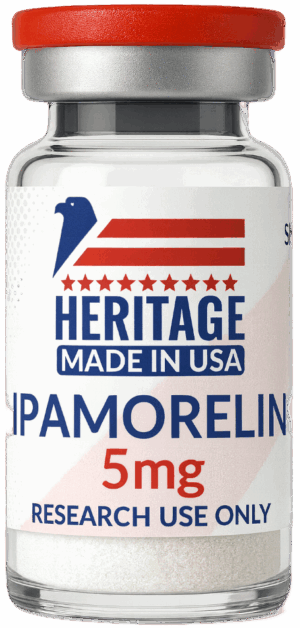
Ipamorelin 5mg
Selective GHS-R (ghrelin receptor) agonist — synthetic pentapeptide (Aib-His-D-2-Nal-D-Phe-Lys-NH₂) First GHRP-receptor agonist with selectivity comparable to GHRH in published research CAS 170851-70-4 For in vitro GH secretagogue research only
For laboratory research use only. Not for human or veterinary consumption. SKU IP5.
Product details.
Specifications
| Sequence | Aib-His-D-2-Nal-D-Phe-Lys-NH₂ |
| Molecular Formula | C38H49N9O5 |
| Molecular Weight | 711.85 g/mol |
| CAS Number | 170851-70-4 |
| PubChem CID | 9831659 |
| Purity | Research-grade |
| Form | Lyophilized powder |
| Quantity | 5mg per vial |
Pharmacology and Receptor Signaling
Ipamorelin binds to the growth hormone secretagogue receptor type 1a (GHS-R1a), a G protein-coupled receptor expressed primarily in anterior pituitary somatotrophs. The binding triggers a phospholipase C-mediated signaling cascade: IP3/DAG release, intracellular calcium mobilization, and protein kinase C (PKC) activation, culminating in growth hormone exocytosis. EC50 has been measured at 1.3 nmol/L in rat pituitary cell assays, with peak GH response occurring at approximately 40 minutes post-administration and a circulating half-life of approximately 2 hours (Gobburu et al., Pharmaceutical Research, 1999).
What distinguishes ipamorelin from earlier GHS-R agonists (hexarelin, GHRP-6, GHRP-2) is its signaling selectivity. While those compounds activate GHS-R1a and also engage other pathways that elevate cortisol and prolactin, ipamorelin produces minimal cross-reactivity at GH-releasing concentrations. This selectivity makes it a valuable tool for researchers studying isolated GHS-R1a-mediated somatotroph activation without confounding adrenocorticotropic or lactotropic effects (Sinha et al., Transl Androl Urol, 2020; PMC7108996).
Research Applications Beyond Growth Hormone
The published literature on ipamorelin extends well beyond somatotroph activation. Svensson et al. examined its effects in bone mineral density studies using dual-energy X-ray absorptiometry (DEXA) and peripheral quantitative computed tomography (pQCT) in murine models, documenting changes in cortical and trabecular bone parameters (Svensson et al., The Journal of Endocrinology, 2000). Greenwood-Van Meerveld et al. investigated ipamorelin in postoperative gastric dysmotility models, where GHS-R1a agonism was associated with effects on gastric emptying rate and smooth muscle contractility (J Exp Pharmacol, 2012; PubMed 27186124).
Additional research contexts include the study of GHS-R1a constitutive activity (the receptor signals at approximately 50% of maximal capacity even without ligand binding), inverse agonism, and biased signaling — areas where ipamorelin serves as a reference agonist for characterizing receptor pharmacology (Holst et al., Molecular Endocrinology, 2003; PubMed 12893882).
Key Research Applications
- Selective GHS-R1a agonism and somatotroph signaling cascade characterization
- Comparative secretagogue studies — selectivity profiling against GHRP-6, GHRP-2, hexarelin
- Dual-pathway growth hormone axis research when paired with GHRH receptor agonists
- GHS-R1a constitutive activity and biased agonism investigations
- Bone metabolism and mineral density research models
- Gastrointestinal motility and smooth muscle contractility studies
Ipamorelin + CJC-1295: Dual-Receptor Axis Research
Ipamorelin (GHS-R1a agonist) and CJC-1295 (GHRH receptor agonist) target different receptors within the same somatotropic axis. The published literature routinely examines these compounds together for dual-pathway somatotroph activation studies, as the two receptor systems converge on complementary intracellular signaling mechanisms in pituitary somatotrophs. Heritage Labs USA offers the CJC-IPA blend for researchers investigating this paired approach.
Frequently Paired With
- CJC-1295 No DAC — Available as CJC-IPA Blend.
- Tesamorelin 5mg — Available as Ipa/Tesa Blend.
- Sermorelin 5mg — Alternative GHRH analog pairing.
Quality and testing
Third-party tested by an independent lab for identity, density and purity. Certificates of analysis are published on the product page and in the COA portal. Manufactured to research-grade standards and shipped in protective packaging.
Storage
- Lyophilized: Store at -20°C, protected from light and moisture
- Reconstituted: 2-8°C, use within 30 days
- Avoid repeated freeze-thaw cycles
References
- Raun K, et al. European Journal of Endocrinology. 1998;139(5):552-561. PubMed 9849822
- Sinha DK, et al. Transl Androl Urol. 2020;9(Suppl 2):S149-S159. PMC7108996
- Gobburu JVS, et al. Pharmaceutical Research. 1999;16:1412-1416.
- Holst B, et al. Molecular Endocrinology. 2003;17(11):2201-2210. PubMed 12893882
- Svensson J, et al. The Journal of Endocrinology. 2000.
- Greenwood-Van Meerveld B, et al. J Exp Pharmacol. 2012;4:149-155. PubMed 27186124
For laboratory research use only. Not for human or veterinary use.

FDA Disclaimer. All products are for research use only (RUO) as defined by the FDA — not for diagnostic, human, or veterinary use. These products have not been evaluated and have not been approved by the U.S. Food and Drug Administration and are not intended to diagnose, treat, cure, or prevent any disease.
Heritage Labs is a chemical supplier providing products strictly for laboratory research, analytical, and in-vitro purposes; it is not a compounding pharmacy or compounding facility under Section 503A, nor an outsourcing facility under Section 503B, of the Federal Food, Drug, and Cosmetic Act.