
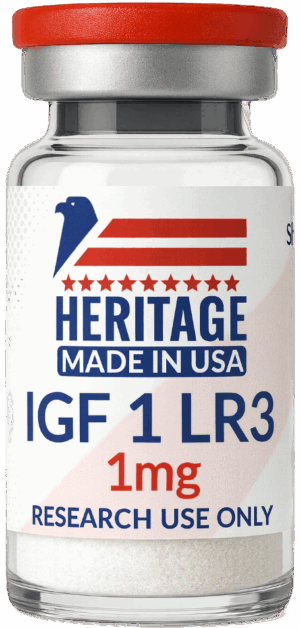
IGF-1 LR3 1mg
Synthetic analog of human Insulin-Like Growth Factor-1 (IGF-1) Contains an arginine substitution at position 3 and an extended chain Research-grade Supplied as a lyophilized powder for laboratory research
For laboratory research use only. Not for human or veterinary consumption. SKU IG1.
Product details.
Why the “Long R3” modification matters
In circulation, native IGF-1 is almost entirely bound by IGFBP-1 through IGFBP-6, leaving only a small free fraction available to the receptor. The Arg3 substitution weakens IGFBP binding while the N-terminal extension stabilizes the molecule, so Long R3 IGF-1 remains free far longer than native IGF-1. This property was first exploited in mammalian cell-culture research, where Long R3 IGF-1 became a standard supplement for sustaining the viability and productivity of cultured cells in reduced-serum media.
Specifications
| Analog | 83-residue IGF-1 analog (Arg3 substitution + 13-residue N-terminal extension) |
| Molecular Weight | ~9111 g/mol |
| CAS Number | 946870-92-4 |
| Molecular Purity | See COA |
| Form | Lyophilized powder |
| Reconstitution | Bacteriostatic (BAC) water |
| Storage | Cool, dry, away from direct light |
| Quantity | 1mg per vial |
Research areas
IGF-1 receptor signaling
Studied for activation of the IGF-1 receptor and the downstream PI3K/Akt and MAPK cascades that govern cellular growth, proliferation, and survival.
Cell-culture research
A standard supplement in serum-free and reduced-serum mammalian cell culture, studied for its ability to sustain cell viability and product yield.
Protein-synthesis models
Investigated in skeletal-muscle and connective-tissue models for its role in protein-synthesis signaling and cellular hypertrophy and hyperplasia pathways.
Metabolic research
Examined for cross-talk with insulin signaling and glucose-uptake pathways in metabolic research models.
Research applications
- Studied in IGF-1 receptor and PI3K/Akt signaling research
- Used as a supplement in mammalian cell-culture models
- Relevant to protein-synthesis and tissue-growth pathway research
- Investigated in metabolic and nutrient-partitioning models
- Used to study sustained IGF-axis activation versus native IGF-1
Quality and testing
Third-party tested by an independent lab for identity, density and purity. Certificates of analysis are published on the product page and in the COA portal. Manufactured to research-grade standards and shipped in protective packaging.
For research use only. Not for human consumption.

FDA Disclaimer. All products are for research use only (RUO) as defined by the FDA — not for diagnostic, human, or veterinary use. These products have not been evaluated and have not been approved by the U.S. Food and Drug Administration and are not intended to diagnose, treat, cure, or prevent any disease.
Heritage Labs is a chemical supplier providing products strictly for laboratory research, analytical, and in-vitro purposes; it is not a compounding pharmacy or compounding facility under Section 503A, nor an outsourcing facility under Section 503B, of the Federal Food, Drug, and Cosmetic Act.