
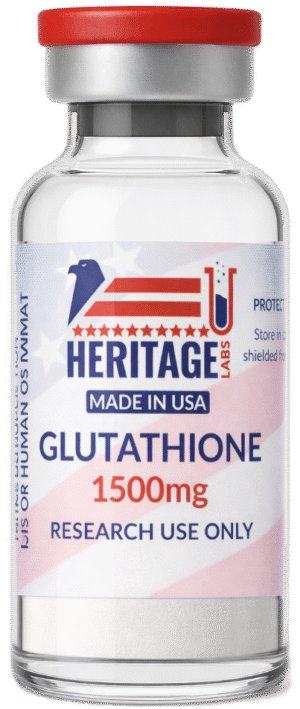
Glutathione 1500mg
Reduced L-Glutathione (GSH) — the cell's primary antioxidant tripeptide 1500mg per vial — highest strength for concentration-response and high-volume protocols For in vitro and preclinical research use only
For laboratory research use only. Not for human or veterinary consumption. SKU GTT.
Product details.
Why glutathione matters in research
GSH participates in three distinct biochemical roles that make it unusually versatile as a research compound. First, it is the dominant substrate for glutathione peroxidase, which reduces hydrogen peroxide and lipid hydroperoxides — the frontline enzymatic antioxidant defense. Second, it conjugates electrophilic xenobiotics and endogenous metabolites through glutathione S-transferase (GST), the major Phase II detoxification pathway. Third, it maintains the thiol redox state of protein cysteine residues, preventing irreversible oxidation that disrupts protein function. These three functions — antioxidant defense, detoxification conjugation, and protein thiol maintenance — converge in tissues with high metabolic or toxic burden: liver, kidney, lung, and immune cells.
Specifications
| Compound | L-Glutathione (reduced, GSH) |
| Sequence | γ-L-Glutamyl-L-cysteinyl-glycine |
| Molecular Weight | 307.32 g/mol |
| CAS | 70-18-8 |
| Form | Lyophilized powder |
| Quantity | 1500mg per vial |
| Purity | Research-grade |
Preclinical research context
Glutathione depletion models are a cornerstone of oxidative stress research. BSO (buthionine sulfoximine) inhibits γ-glutamylcysteine synthetase to deplete intracellular GSH, and exogenous GSH or precursors like NAC are then administered to study rescue kinetics. This 1500mg formulation supports high-concentration protocols where smaller quantities would require impractical multi-vial preparation. Research areas where GSH is actively studied include hepatoprotection models (acetaminophen-induced glutathione depletion), mitochondrial redox balance, immune cell activation and proliferation (T-cells are particularly sensitive to GSH availability), and neuronal oxidative damage models.
GSH vs. NAC — different tools, different questions
N-acetylcysteine (NAC) is a cysteine prodrug — it raises intracellular GSH by providing the rate-limiting amino acid for synthesis. Exogenous GSH, by contrast, is the end product itself. They answer different experimental questions: NAC probes whether the synthesis pathway is intact and responsive; GSH probes whether the effector molecule itself is sufficient. Researchers studying the synthetic pathway use NAC. Researchers studying direct GSH-dependent enzyme activity or bypassing synthesis bottlenecks use reduced glutathione.
Frequently paired with
- NAD+ 500mg — Coenzyme in redox reactions; NAD+/NADH and GSH/GSSG ratios are coupled through shared metabolic pathways
- NAD+ 1000mg — Higher-concentration NAD+ for intensive redox and mitochondrial research
- BPC-157 5mg — Cytoprotective peptide studied alongside GSH in tissue protection models
- GHK-Cu 50mg — Copper peptide with overlapping antioxidant and tissue remodeling research applications
Quality and testing
Third-party tested by an independent lab for identity, density and purity. Certificates of analysis are published on the product page and in the COA portal. Manufactured to research-grade standards and shipped in protective packaging.
Storage
- Lyophilized: Store at -20°C for long-term stability; protect from light and moisture
- Reconstituted: 2-8°C, use within 30 days
For laboratory research use only. Not for human or veterinary use.

FDA Disclaimer. All products are for research use only (RUO) as defined by the FDA — not for diagnostic, human, or veterinary use. These products have not been evaluated and have not been approved by the U.S. Food and Drug Administration and are not intended to diagnose, treat, cure, or prevent any disease.
Heritage Labs is a chemical supplier providing products strictly for laboratory research, analytical, and in-vitro purposes; it is not a compounding pharmacy or compounding facility under Section 503A, nor an outsourcing facility under Section 503B, of the Federal Food, Drug, and Cosmetic Act.