
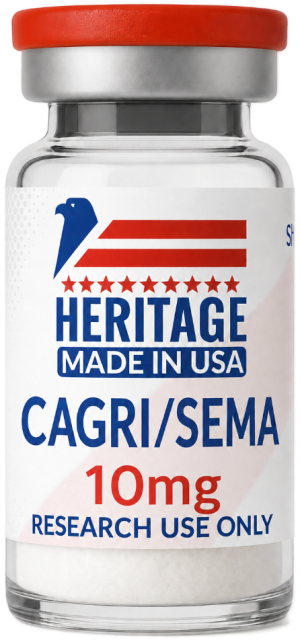
Cagrilintide/Semaglutide 10mg
Dual peptide blend: Cagrilintide (5mg) + Semaglutide (5mg) co-lyophilized in a single vial Long-acting amylin analog paired with GLP-1 receptor agonist — distinct, complementary signaling pathways Research-grade · Lyophilized powder For in vitro dual-pathway research only
For laboratory research use only. Not for human or veterinary consumption. SKU CS10.
Product details.
Specifications
| Content | 5 mg Cagrilintide + 5 mg Semaglutide per vial |
| Format | Co-lyophilized powder |
| Total Peptide Mass | 10 mg per vial |
| Purity | research-grade (, each component) |
| Identity | identity testing confirmed for both components |
| Solubility | Soluble in sterile or bacteriostatic water |
Cagrilintide — Molecular Profile
Cagrilintide is a 37-amino-acid synthetic analog of human amylin (islet amyloid polypeptide, IAPP), modified with a C18 fatty diacid acylation that enables reversible, non-covalent binding to serum albumin. The albumin association produces a depot effect that substantially extends the circulating half-life compared to native amylin, whose unmodified form is cleared in minutes (CAS 2196070-45-4; molecular weight ≈4,034 Da in the acylated form). Cagrilintide engages all three amylin receptor subtypes — AMY1, AMY2, and AMY3 — each a heterodimer of the calcitonin receptor (CTR) paired with one of three receptor activity-modifying proteins (RAMP1, RAMP2, RAMP3). The design rationale for acylated amylin analogs was described by Lau et al. (Journal of Medicinal Chemistry, 2015; PubMed 26288685).
Semaglutide — Molecular Profile
Semaglutide is a 31-amino-acid GLP-1 receptor agonist engineered to resist DPP-IV degradation and to bind serum albumin via a C18 fatty diacid spacer. Native GLP-1 has a circulating half-life of approximately two minutes due to rapid enzymatic cleavage; semaglutide’s modifications extend its functional half-life dramatically while preserving full GLP-1 receptor affinity. Receptor engagement initiates a cAMP/PKA signaling cascade in pancreatic beta cells and activates GLP-1 receptors expressed in hypothalamic appetite-regulating centers, including the arcuate nucleus. The pharmacokinetic and receptor-binding characterization of semaglutide has been published in multiple peer-reviewed sources (Lau et al., Journal of Medicinal Chemistry, 2015).
The Blend Rationale
Amylin and GLP-1 are distinct hormones that act through separate receptor systems and engage different neuronal populations. Amylin receptor agonists primarily act on hindbrain circuits, including the area postrema and nucleus tractus solitarius. GLP-1 receptor agonists engage both peripheral targets and central circuits in the hypothalamus and brainstem. Because the two pathways are mechanistically distinct, they have been studied in combination as a means of probing parallel and potentially additive signaling at the metabolic-regulatory axis. Enebo et al. published the first major preclinical and early-phase characterization of this specific combination in The Lancet in 2021, reporting on cagrilintide co-administered with semaglutide in a Phase 1b ranging study (PubMed 34004180). The 1:1 mass ratio at 5 mg / 5 mg used here mirrors the most commonly referenced research configuration for this peptide pair. Pre-blending the two compounds in a single lyophilized vial eliminates the volume-matching and concentration-calculation steps required when reconstituting two separate vials, and reduces the contamination risk associated with cross-vial transfer.
Receptor Pharmacology
The amylin receptor system represents one of the more intricate GPCR signaling networks studied in metabolic research. The three subtypes — AMY1 (CTR + RAMP1), AMY2 (CTR + RAMP2), and AMY3 (CTR + RAMP3) — each exhibit distinct ligand affinity profiles and tissue distribution patterns (Hay et al., Pharmacological Reviews, 2015; PubMed 26023145). The GLP-1 receptor (GLP-1R) is a class B GPCR primarily coupled to Gαs, with downstream cAMP elevation and PKA activation as the canonical signal. Both receptor systems also recruit β-arrestin and undergo internalization with kinetics that depend on the specific agonist and tissue context.
Research Applications
- Parallel-pathway investigation: amylin receptor signaling alongside GLP-1 receptor activation in metabolic models
- Hindbrain (area postrema, NTS) versus hypothalamic circuit comparative mapping
- Acylated peptide pharmacokinetics — albumin-binding dynamics and depot release modeling for two co-administered compounds
- Comparative receptor occupancy and internalization kinetics studies
- Energy balance, glucose homeostasis, and feeding-behavior research models
- Structure-activity analysis of acylated peptide hormone analogs
Purity and Analytical Testing
Each lot of the blend is verified by independent third-party analytical testing. Reversed-phase confirms research-grade purity for each component; identity testing confirms molecular identity for both peptides. Endotoxin screening is performed on every production lot. Reconstitution and Handling Reconstitute with bacteriostatic water by injecting the solvent slowly along the inside wall of the vial. Do not direct the stream onto the lyophilized powder. Swirl gently — do not shake — until completely dissolved. The reconstituted solution should be clear and colorless. A 2 mL reconstitution volume yields a concentration of 2,500 mcg/mL of each peptide component (5,000 mcg/mL total peptide). See the Reconstitution Guide for the full protocol.
Storage
- Lyophilized: Store at -20°C for long-term stability. Protect from light and moisture.
- Reconstituted: 2-8°C, use within 21-28 days.
- Avoid repeated freeze-thaw cycles. Aliquot before freezing if longer-term storage of the reconstituted solution is required.
References
- Enebo LB, Berthelsen KK, Kankam M, et al. The Lancet. 2021;397(10286):1736-1748. PubMed 34004180
- Lau J, Bloch P, Schäffer L, et al. Journal of Medicinal Chemistry. 2015;58(18):7370-7380. PubMed 26288685
- Hay DL, Garelja ML, Poyner DR, Walker CS. Pharmacological Reviews. 2015;67(3):564-600. PubMed 26023145
For laboratory research use only. Not for human or veterinary use.

FDA Disclaimer. All products are for research use only (RUO) as defined by the FDA — not for diagnostic, human, or veterinary use. These products have not been evaluated and have not been approved by the U.S. Food and Drug Administration and are not intended to diagnose, treat, cure, or prevent any disease.
Heritage Labs is a chemical supplier providing products strictly for laboratory research, analytical, and in-vitro purposes; it is not a compounding pharmacy or compounding facility under Section 503A, nor an outsourcing facility under Section 503B, of the Federal Food, Drug, and Cosmetic Act.