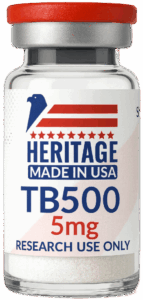

Wolverine Stack: BPC-157 + TB-500
What Is the Wolverine Stack?
"Wolverine stack" is the widely used nickname for a blend of two research peptides, BPC-157 and TB-500, co-lyophilized in one vial in equal amounts. They are two of the most studied peptides in preclinical tissue-repair research, and each works through a different route, which is why they are so often paired.
Heritage Labs sells the blend in two sizes for laboratory research use only:
| Product | BPC-157 | TB-500 | Total per vial |
|---|---|---|---|
| Wolverine 10mg | 5 mg | 5 mg | 10 mg |
| Wolverine 20mg | 10 mg | 10 mg | 20 mg |
What Is in the Vial
| Ingredient | What it is | Main research focus |
|---|---|---|
| BPC-157 | 15-amino-acid peptide (GEPPPGKPADDAGLV), a partial sequence of a protein found in human gastric juice | Blood-vessel growth, tendon and ligament models, gastrointestinal models |
| TB-500 | Synthetic thymosin beta-4: 43 amino acids with the LKKTETQ actin-binding motif | Cell migration, wound repair, cardiac tissue models |
Why BPC-157 and TB-500 Are Combined
In laboratory models, repairing tissue needs two things to happen: new blood vessels have to reach the area, and cells have to move into it and rebuild. The two peptides have been studied on different sides of that work:
| BPC-157 | TB-500 (thymosin beta-4) | |
|---|---|---|
| Studied for | Signaling new blood-vessel growth, and helping connective-tissue cells survive and spread | Moving cells, by controlling actin, the protein scaffolding cells use to crawl |
| Pathway | VEGFR2–Akt–eNOS (blood vessels); FAK–paxillin (tendon cells) | Actin sequestering; ILK–Akt (cell survival) |
| Typical models | Tendon, ligament, muscle and gut | Skin wounds and heart tissue |
Because they reach repair through different routes, researchers pair them to study both at once in a single preparation. We are not aware of peer-reviewed studies of the two-peptide blend itself; the research behind it is the research on each peptide, summarized below.
What Research Has Studied
BPC-157
- Blood vessels: in chick-embryo and rat hind-limb models and in endothelial-cell culture, BPC-157 promoted new blood-vessel formation, associated with activation of the VEGFR2–Akt–eNOS pathway.[1]
- Tendon cells: in rat Achilles-tendon explants, BPC-157 accelerated tendon-fibroblast outgrowth, improved cell survival under oxidative stress, and increased fibroblast migration, linked to the FAK–paxillin pathway.[2]
- Broader research: reviews describe its study in gastrointestinal, muscle, ligament and bone models, mostly in animals.[3]
TB-500 (thymosin beta-4)
- Wound repair: in a rat full-thickness wound model, thymosin beta-4 increased re-epithelialization, wound contraction, collagen deposition and blood-vessel formation, and stimulated keratinocyte migration.[4]
- Heart tissue: a 2004 Nature study found thymosin beta-4 promoted heart-muscle and endothelial cell migration and survival, and improved cardiac function in mice after coronary artery ligation, through the ILK–Akt pathway.[5]
- Broader research: it is found in nearly every mammalian cell, binds actin through its LKKTETQ motif, and has been reviewed as a multi-functional regenerative peptide.[6]
Heritage's TB-500 is a synthetic version of the full 43-amino-acid thymosin beta-4 sequence; the studies above used thymosin beta-4.
How to Reconstitute the Wolverine Stack
Add bacteriostatic water slowly down the inside wall of the vial, then swirl gently until the powder dissolves; do not shake.
| Vial | Water added | Total peptide | BPC-157 | TB-500 |
|---|---|---|---|---|
| 10 mg (5 + 5) | 1 mL | 10 mg/mL | 5 mg/mL | 5 mg/mL |
| 10 mg (5 + 5) | 2 mL | 5 mg/mL | 2.5 mg/mL | 2.5 mg/mL |
| 10 mg (5 + 5) | 3 mL | 3.33 mg/mL | 1.67 mg/mL | 1.67 mg/mL |
| 20 mg (10 + 10) | 2 mL | 10 mg/mL | 5 mg/mL | 5 mg/mL |
| 20 mg (10 + 10) | 3 mL | 6.67 mg/mL | 3.33 mg/mL | 3.33 mg/mL |
| 20 mg (10 + 10) | 5 mL | 4 mg/mL | 2 mg/mL | 2 mg/mL |
For any other volume, use the reconstitution calculator.
Storage
- Lyophilized (unopened): store sealed at −20°C.
- Reconstituted: store at 2–8°C and use within 30 days.
- Keep vials out of light, and use a new sterile needle for every draw.
Frequently Asked Questions
What is the Wolverine stack?
The Wolverine stack is the nickname for a research blend of BPC-157 and TB-500 in equal amounts in one vial. Heritage Labs sells it in 10 mg (5 + 5) and 20 mg (10 + 10) sizes for laboratory research use only.
Why are BPC-157 and TB-500 combined?
They have been studied on different sides of tissue repair in laboratory models: BPC-157 in signaling new blood-vessel growth and supporting connective-tissue cells, TB-500 (thymosin beta-4) in moving cells by controlling actin. Pairing them lets researchers study both routes in one preparation.
What is the difference between BPC-157 and TB-500?
BPC-157 is a 15-amino-acid peptide from a gastric-juice protein, studied mainly in blood-vessel, tendon, ligament and gut models. TB-500 is synthetic thymosin beta-4, a 43-amino-acid actin-binding peptide studied mainly in cell migration, wound and heart-tissue models.
What is the difference between Wolverine 10mg and 20mg?
Only the amount: the 10 mg vial holds 5 mg of each peptide, the 20 mg vial holds 10 mg of each. The ratio is 1:1 in both.
How do you reconstitute the Wolverine stack?
Add bacteriostatic water slowly down the inside of the vial and swirl gently until dissolved. A 10 mg vial in 2 mL gives 5 mg/mL total (2.5 mg/mL of each peptide); a 20 mg vial in 2 mL gives 10 mg/mL total (5 mg/mL of each).
How should the Wolverine stack be stored?
Store sealed vials at −20°C. After reconstitution, refrigerate at 2–8°C and use within 30 days.
Where can I buy the Wolverine stack for research?
Heritage Labs USA sells Wolverine 10mg and Wolverine 20mg. We are veteran-owned and ship from the United States; weekday orders placed before 12:00 PM ET ship the same day.
References
- Hsieh MJ, et al. Therapeutic potential of pro-angiogenic BPC157 is associated with VEGFR2 activation and up-regulation. J Mol Med (Berl). 2017;95(3):323-333. PubMed
- Chang CH, et al. The promoting effect of pentadecapeptide BPC 157 on tendon healing involves tendon outgrowth, cell survival, and cell migration. J Appl Physiol. 2011;110(3):774-780. PubMed
- Sikiric P, et al. Novel Cytoprotective Mediator, Stable Gastric Pentadecapeptide BPC 157. Vascular Recruitment and Gastrointestinal Tract Healing. Curr Pharm Des. 2018;24(18):1990-2001. PubMed
- Malinda KM, et al. Thymosin beta4 accelerates wound healing. J Invest Dermatol. 1999;113(3):364-368. PubMed
- Bock-Marquette I, et al. Thymosin beta4 activates integrin-linked kinase and promotes cardiac cell migration, survival and cardiac repair. Nature. 2004;432(7016):466-472. PubMed
- Goldstein AL, Hannappel E, Sosne G, Kleinman HK. Thymosin β4: a multi-functional regenerative peptide. Basic properties and clinical applications. Expert Opin Biol Ther. 2012;12(1):37-51. PubMed
For laboratory research use only. Not for human or veterinary use.