
MOTS-C Research Guide
What Is MOTS-C?
MOTS-c is a 16-amino-acid peptide encoded in mitochondrial DNA, not in the cell's nucleus. Its name stands for mitochondrial open reading frame of the 12S rRNA type-c: it was found in 2015 hidden inside the gene for the mitochondria's 12S ribosomal RNA.[1]
That discovery is why researchers study it. Mitochondria were long seen as the cell's power plants, taking orders from the nucleus. MOTS-c showed that mitochondria also send their own signals, reporting on the cell's energy state and influencing how the rest of the cell handles fuel.
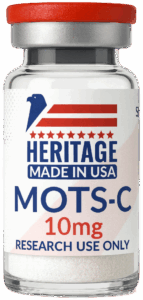
Heritage Labs sells MOTS-C 10mg and MOTS-C 40mg for laboratory research use only.
Specifications
| Sequence | Met-Arg-Trp-Gln-Glu-Met-Gly-Tyr-Ile-Phe-Tyr-Pro-Arg-Lys-Leu-Arg (MRWQEMGYIFYPRKLR) |
| Length | 16 amino acids |
| Molecular formula | C101H152N28O22S2 |
| Molecular weight | 2174.64 g/mol |
| CAS number | 1627580-64-6 |
| Gene origin | Mitochondrial 12S rRNA region |
| Form | Lyophilized powder (10 mg or 40 mg per vial) |
How MOTS-C Works
MOTS-c reaches the cell's main energy sensor, AMPK, by an indirect route:
- It slows the folate cycle and the purine-building pathway attached to it.[1]
- That causes a natural intermediate, AICAR, to build up. AICAR is a known activator of AMPK.
- AMPK switches on, shifting the cell toward using fuel and maintaining energy balance. In the original study, skeletal muscle appeared to be its main target tissue.[1]
Under metabolic stress, MOTS-c also moves from the mitochondria into the nucleus, in an AMPK-dependent way, and changes the activity of a broad set of nuclear genes, including antioxidant-response genes, working with stress-response factors such as NRF2.[2] That is a mitochondrion directly regulating the nuclear genome, which had not been shown before.
What Research Has Studied
- Metabolism (mice): MOTS-c treatment prevented age-dependent and high-fat-diet-induced insulin resistance and diet-induced obesity.[1]
- Gene regulation (cells): in response to glucose restriction, MOTS-c in the nucleus regulated genes tied to antioxidant response and stress adaptation.[2]
- Physical capacity and aging (mice): MOTS-c enhanced physical performance in young (2-month), middle-aged (12-month) and old (22-month) mice, regulated skeletal-muscle metabolism, and helped muscle precursor cells adapt to metabolic stress. Treatment started late in life increased physical capacity in old mice.[3]
These findings come from mouse and cell studies.
MOTS-C vs NAD+
Both sit at the center of cellular energy research, but at different points. NAD+ is the coenzyme that fuels sirtuins, PARPs and the electron transport chain. MOTS-c is a signaling peptide that activates AMPK through the folate cycle. They act on complementary pathways rather than the same one.
How to Reconstitute MOTS-C
Add bacteriostatic water slowly down the inside wall of the vial, then swirl gently until the powder dissolves; do not shake.
| Vial | Water added | Concentration |
|---|---|---|
| 10 mg | 1 mL | 10 mg/mL |
| 10 mg | 2 mL | 5 mg/mL |
| 10 mg | 3 mL | 3.33 mg/mL |
| 40 mg | 2 mL | 20 mg/mL |
| 40 mg | 3 mL | 13.33 mg/mL |
| 40 mg | 5 mL | 8 mg/mL |
For any other volume, use the reconstitution calculator.
Storage
- Lyophilized (unopened): store sealed at −20°C.
- Reconstituted: store at 2–8°C and use within 30 days.
- Keep vials out of light, and use a new sterile needle for every draw.
Frequently Asked Questions
What is MOTS-c?
MOTS-c is a 16-amino-acid peptide encoded in mitochondrial DNA, discovered in 2015. It is studied as a signal the mitochondria use to influence how cells handle energy. Heritage Labs sells it for laboratory research use only.
What does MOTS-c stand for?
Mitochondrial open reading frame of the 12S rRNA type-c, after the mitochondrial 12S ribosomal RNA gene where its code was found.
How does MOTS-c work?
It slows the folate cycle, which lets AICAR build up and activate AMPK, the cell's energy sensor. Under metabolic stress it also moves into the nucleus and regulates genes, including antioxidant-response genes.
Is MOTS-c made naturally?
Yes. MOTS-c is encoded in mitochondrial DNA. The research product is synthetic, with the same 16-amino-acid sequence.
What is the difference between MOTS-C 10mg and 40mg?
Only the amount of peptide per vial: 10 mg or 40 mg of the same 16-amino-acid sequence.
How do you reconstitute MOTS-c?
Add bacteriostatic water slowly down the inside of the vial and swirl gently until dissolved. A 10 mg vial in 2 mL gives 5 mg/mL; a 40 mg vial in 2 mL gives 20 mg/mL.
Where can I buy MOTS-c for research?
Heritage Labs USA sells MOTS-C 10mg and MOTS-C 40mg. We are veteran-owned and ship from the United States; weekday orders placed before 12:00 PM ET ship the same day.
References
- Lee C, et al. The mitochondrial-derived peptide MOTS-c promotes metabolic homeostasis and reduces obesity and insulin resistance. Cell Metab. 2015;21(3):443-454. PubMed
- Kim KH, Son JM, Benayoun BA, Lee C. The Mitochondrial-Encoded Peptide MOTS-c Translocates to the Nucleus to Regulate Nuclear Gene Expression in Response to Metabolic Stress. Cell Metab. 2018;28(3):516-524. PubMed
- Reynolds JC, et al. MOTS-c is an exercise-induced mitochondrial-encoded regulator of age-dependent physical decline and muscle homeostasis. Nat Commun. 2021;12(1):470. PubMed
For laboratory research use only. Not for human or veterinary use.