CJC-1295 + Ipamorelin Guide
What Is CJC-1295 + Ipamorelin?
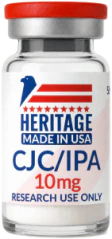
CJC-1295 + Ipamorelin is a research blend of two growth-hormone secretagogue peptides, CJC-1295 (without DAC) and Ipamorelin, at 5 mg each in one 10 mg vial. Both signal the pituitary to release growth hormone, but each does it through a different receptor, which is the reason they are paired.
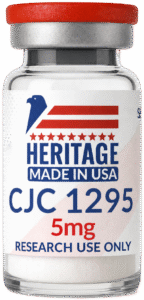
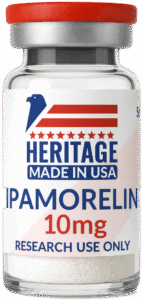
Heritage Labs sells the CJC-1295/Ipamorelin 10mg blend, plus CJC-1295 and Ipamorelin on their own, for laboratory research use only.
What Is in the Vial
| Ingredient | Amount | What it is | Receptor it acts on |
|---|---|---|---|
| CJC-1295 (no DAC) | 5 mg | Modified GRF (1-29): the first 29 amino acids of growth hormone-releasing hormone (GHRH), with four substitutions (positions 2, 8, 15 and 27) that resist enzyme breakdown | GHRH receptor |
| Ipamorelin | 5 mg | Synthetic pentapeptide (Aib-His-D-2-Nal-D-Phe-Lys-NH2) | Ghrelin receptor (GHS-R1a) |
Why CJC-1295 and Ipamorelin Are Combined
The pituitary cells that release growth hormone have two separate "on" switches:
- The GHRH receptor, the switch for the body's own growth hormone-releasing hormone. CJC-1295 acts here.
- The ghrelin receptor (GHS-R1a), a separate switch. Ipamorelin acts here.
Because the two switches work through different signaling routes, flipping both produces more than either alone. In rat pituitary cells, a GHRH-type peptide and a ghrelin-receptor peptide released growth hormone through different receptors and, given together, had a synergistic effect on release.[1] That is the logic of the pair: one peptide on each receptor.
Ipamorelin is the ghrelin-receptor peptide usually chosen for this because of its selectivity (see below). We are not aware of peer-reviewed studies of this exact two-peptide blend; the research behind it is the research on each peptide and on the two receptor pathways.
What Research Has Studied
Ipamorelin: a selective ghrelin-receptor peptide
- In rat pituitary cells and in rats, ipamorelin released growth hormone with potency and efficacy similar to the older peptide GHRP-6, acting through the ghrelin (GHRP) receptor.[2]
- In swine, GHRP-6 and GHRP-2 also raised ACTH and cortisol. Ipamorelin did not, even at more than 200 times the amount needed for growth-hormone release, and it did not change FSH, LH, prolactin or TSH. The authors called it the first growth-hormone secretagogue with selectivity similar to GHRH.[2]
CJC-1295 without DAC (Modified GRF 1-29)
- Natural GHRH is broken down within minutes by the enzyme DPP-IV. Modified GRF (1-29) keeps the active 1-29 sequence but swaps four amino acids so it resists that breakdown, giving it a longer working life while still acting in short pulses.
- "Without DAC" matters. The original CJC-1295 carried a Drug Affinity Complex, a chemical group that binds the peptide to albumin in the blood and stretches its activity over days. Research on GRF(1-29)–albumin conjugates in rats showed they still activate the GHRH receptor on the pituitary.[3] The no-DAC version in this blend is the short-acting form.
CJC-1295 With DAC vs Without DAC
| Without DAC (in this blend) | With DAC | |
|---|---|---|
| Also called | Modified GRF (1-29), Mod GRF 1-29 | CJC-1295 DAC |
| Albumin binding | No | Yes, through the Drug Affinity Complex |
| Activity profile | Short-acting, pulse-like | Extended, over days |
| Heritage product | CJC-1295 5mg | CJC-1295 with DAC 5mg |
How to Reconstitute CJC-1295 + Ipamorelin
Add bacteriostatic water slowly down the inside wall of the vial, then swirl gently until the powder dissolves; do not shake.
| Water added | Total peptide | CJC-1295 | Ipamorelin |
|---|---|---|---|
| 1 mL | 10 mg/mL | 5 mg/mL | 5 mg/mL |
| 2 mL | 5 mg/mL | 2.5 mg/mL | 2.5 mg/mL |
| 3 mL | 3.33 mg/mL | 1.67 mg/mL | 1.67 mg/mL |
For any other volume, use the reconstitution calculator.
Storage
- Lyophilized (unopened): store sealed at −20°C.
- Reconstituted: store at 2–8°C and use within 30 days.
- Keep vials out of light, and use a new sterile needle for every draw.
Frequently Asked Questions
What is CJC-1295 + Ipamorelin?
A research blend of CJC-1295 without DAC (5 mg) and Ipamorelin (5 mg) in one 10 mg vial. Both are growth-hormone secretagogue peptides, sold for laboratory research use only.
Why are CJC-1295 and Ipamorelin combined?
They act on two different receptors that both trigger growth-hormone release: CJC-1295 on the GHRH receptor and Ipamorelin on the ghrelin receptor. In rat pituitary cells, peptides acting on these two receptors had a synergistic effect when given together.
What is the difference between CJC-1295 and Ipamorelin?
CJC-1295 (no DAC) is a 29-amino-acid GHRH analog that acts on the GHRH receptor. Ipamorelin is a 5-amino-acid peptide that acts on the ghrelin receptor and, in animal research, released growth hormone without raising ACTH or cortisol.
What does "no DAC" mean?
DAC (Drug Affinity Complex) is a chemical group that binds CJC-1295 to albumin and extends its activity over days. CJC-1295 without DAC, also called Modified GRF 1-29, lacks it and is short-acting. The blend uses the no-DAC form.
How do you reconstitute CJC-1295 + Ipamorelin?
Add bacteriostatic water slowly down the inside of the vial and swirl gently until dissolved. In 2 mL, total concentration is 5 mg/mL (2.5 mg/mL of each peptide).
How should CJC-1295 + Ipamorelin be stored?
Store sealed vials at −20°C. After reconstitution, refrigerate at 2–8°C and use within 30 days.
Where can I buy CJC-1295 + Ipamorelin for research?
Heritage Labs USA sells the CJC-1295/Ipamorelin 10mg blend. We are veteran-owned and ship from the United States; weekday orders placed before 12:00 PM ET ship the same day.
References
- Cheng K, Chan WW, Barreto A Jr, Convey EM, Smith RG. The synergistic effects of His-D-Trp-Ala-Trp-D-Phe-Lys-NH2 on growth hormone (GH)-releasing factor-stimulated GH release and intracellular adenosine 3',5'-monophosphate accumulation in rat primary pituitary cell culture. Endocrinology. 1989;124(6):2791-2798. PubMed
- Raun K, et al. Ipamorelin, the first selective growth hormone secretagogue. Eur J Endocrinol. 1998;139(5):552-561. PubMed
- Jetté L, et al. Human growth hormone-releasing factor (hGRF)1-29-albumin bioconjugates activate the GRF receptor on the anterior pituitary in rats. Endocrinology. 2005;146(7):3052-3058. PubMed
For laboratory research use only. Not for human or veterinary use.